The bullying presence of a big, undiscovered "Planet Nine" isn't necessary to explain the strange orbits of a handful of objects in the outer reaches of the solar system, new research suggests.
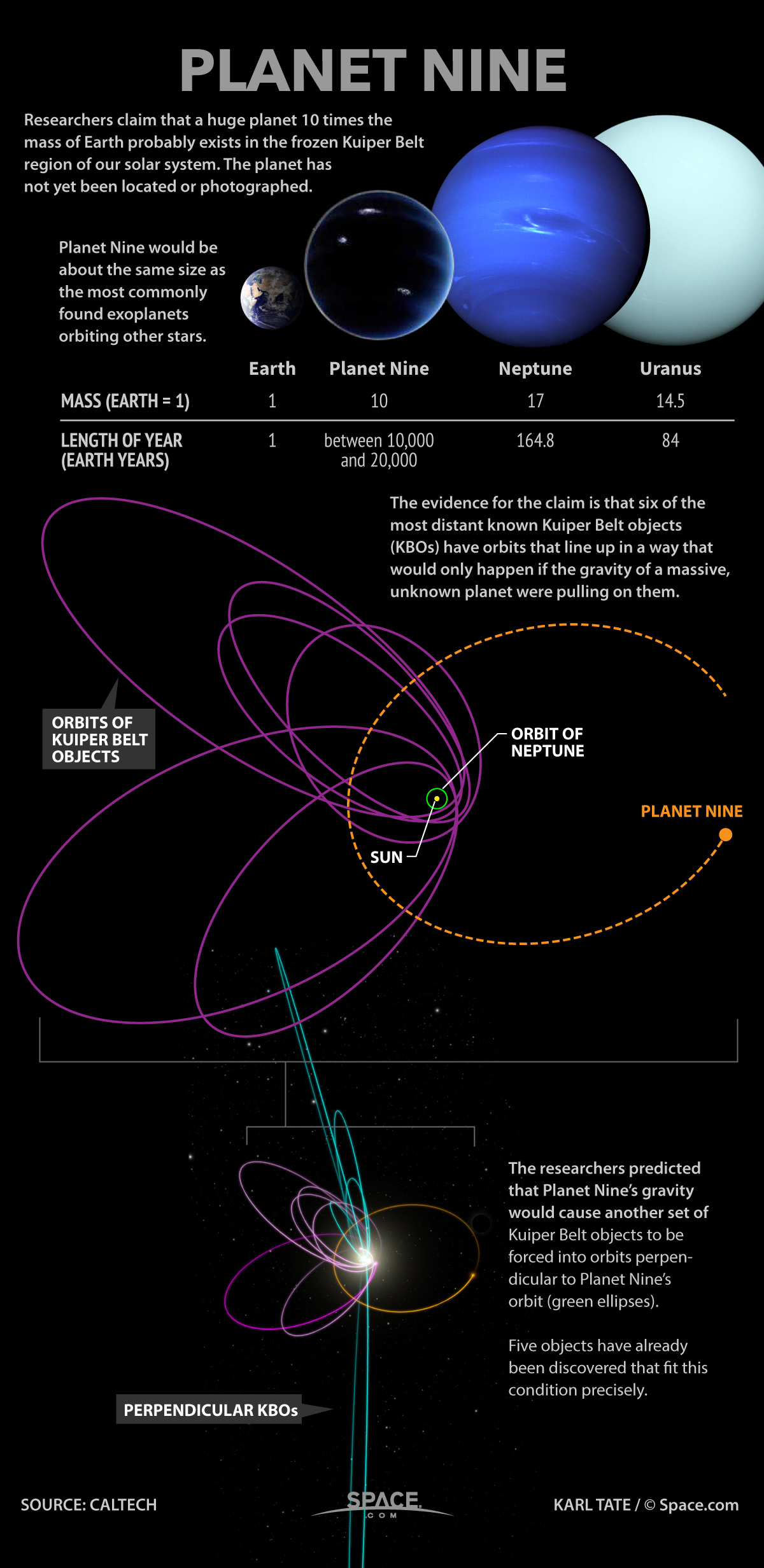
Last month, Konstantin Batygin and Mike Brown, both astronomers at the California Institute of Technology (Caltech) in Pasadena, proposed the existence of Planet Nine, a world perhaps 10 times more massive than Earth that orbits far beyond Pluto, completing one lap around the sun every 10,000 to 20,000 Earth years.
Batygin and Brown didn't see Planet Nine; rather, they inferred its existence based on the odd orbital characteristics of six bodies in the "scattered disk" portion of the Kuiper Belt, a realm of icy bodies that lies beyond Neptune. For example, these six objects all have similar "arguments of perihelion." ['Planet Nine' Worlds Are the Most Common Ones We Know (Infographic)]-
A body's argument of perihelion is basically the ratio of how much it pitches (wobbles forward or backward) to how much it rolls (moves left or right) as it orbits the sun, said Ann-Marie Madigan, a postdoctoral researcher at the University of California, Berkeley. This characteristic should be random from one Kuiper Belt object (KBO) to another, she added.
Imagine seeing a number of boats spread across San Francisco Bay that are all pitching and rolling in the same direction, and with the same pitch/roll ratio, Madigan said Jan. 26 during a talk at the SETI (Search for Extraterrestrial Intelligence) Institute in Mountain View, California.
"That would be really strange," Madigan said. "And so this is why it's so strange that these minor planets in the outer solar system are doing this."
Therefore, something must be shaping the orbits of these far-flung bodies, the reasoning goes. Batygin and Brown believe the culprit is the hypothesized Planet Nine; their computer models suggest this undiscovered world is about 10 times more massive than Earth and orbits the sun on a highly elliptical path, coming within perhaps 200 astronomical units (AU) of the sun and getting as far away as 600 to 1,200 AU. (One AU is the average distance from Earth to the sun — about 93 million miles, or 150 million kilometers. For perspective, Neptune orbits 30 AU from the sun, and Pluto never gets more than 49 AU from our star.)
But Madigan and her co-author Michael McCourt of the Harvard-Smithsonian Center for Astrophysics say there's another possible explanation. Modeling work performed by the duo suggests that the scattered-disk objects could "self-organize," pushing and pulling each other into their unusual orbits — as long as there are a whole lot of them out there. ['Planet Nine': Facts About the Mysterious World (Infographic)]-
If the total mass of all of the minor planets in the scattered disk is roughly equivalent to the mass of Earth, the resulting orbit shaping would have occurred within about 600 million years of the solar system's birth, Madigan said during her SETI Institute talk.
"So we really need that much mass in minor planets for this to happen in the solar system," she said. "If there was much less mass, this wouldn't occur [with]in the age of the solar system."
See more at: http://www.space.com/31817-planet-nine-existence-question.html#sthash.QyGavDy6.dpuf


